

Our story

"I want to make shoelaces."
This is something the CEO has been saying for years.
However, since we are not primarily a manufacturing company, we do not have the know-how or connections.
If we are to create something, there is no meaning and no chance of success unless we create something that does not exist in the world.
Although the project had stalled for a long time, the planning team was aware that making shoelaces was something they wanted to achieve someday.
Eventually, it just so happened that I became obsessed with the charm of "old scarves" and at the same time I was belatedly becoming aware of the SDGs and the fact that the global environment seemed to be in quite a bad state, so I decided to continue in that direction and start a shoelace business.
"Create something that has never existed before using what we have now."
Ideally, it would be ideal if we could start by developing materials that are kind to the earth.
However, it is a bit difficult with our technology and knowledge.
However, we were able to create something completely new and unprecedented using something that already existed.
Of course it's not easy.
Creating something from scratch until I achieved the ideal result was a constant series of setbacks.
However, I was able to meet the craftsmen who are currently in charge of production, and together we have repeatedly improved our products, and we have now reached the point where we can continue to produce our products stably, even though the number is small.
About the materials used
When the brand first started, they used to dismantle old kimonos, but now they make shoelaces using deadstock kimono fabric, which they recommend as the ideal "materials," as well as second-hand and vintage scarves.
I believe that being able to give new value to things that already exist, things that can no longer be used for their original purpose, will also have a positive effect on the Earth.
It also uses scraps of Kurume Kasuri fabric and traditional African fabrics.
I believe that in order to preserve traditions, it is necessary to publicize them, so I hope to be able to help in this regard, however small my contribution may be.
Scraps are produced during the production process, but these are reused by our sister brand , OANDE , and reborn as bags with wonderful individuality.
About "Scarf Shoelaces"
We stock second-hand and vintage scarves in bulk.
Many scarves are damaged to the point that they would be unusable as scarves, and are reborn with a whole new value as shoelaces. Of course, some can be used as scarves as they are, but when they are made into shoelaces, they take on a whole new charm that is truly wonderful.
Scarves are really difficult to work with, as they all come in different sizes and textures.
It is also not possible to cut in layers.
In other words, basically, everything is done one piece at a time.
If the work could not be done in bulk, it would be impossible to do it in a factory. We talked to many places and everyone tried to find a way to make it happen, but it did not come to fruition, and now it is produced by the reliable skills of only a few craftsmen.
First, the washing and ironing.
Of course, everything is done by hand, checking the vertical grain of each piece.
Be careful and careful. This will have a big impact on the final result. 
After that, the fabric is distributed to the craftsmen in charge and production begins.
The scarves are not easy to make, as they can be either soft and squishy or too taut and unruly, so we cut them into thin strips, iron them to shape the finished width, and then finally sew them.
I know I'm repeating myself here, but sewing is really difficult, making sure it doesn't shrink, stretch, or distort...
Each piece is carefully crafted by the hands of artisans with incredible concentration. 
Once the sewing is complete, the length is adjusted and the ends are processed, which is also an important technique for all materials.
It requires precision, attention to detail, and manual dexterity. 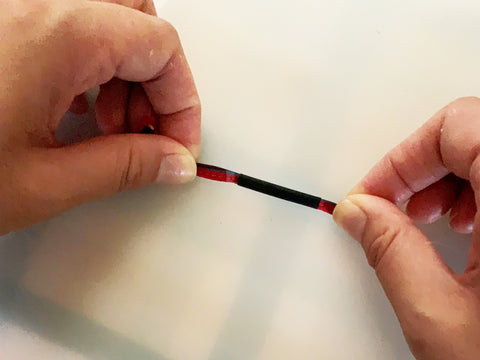

List of scarf shoelaces
About "Kimono Shoelaces"
As mentioned above, we mainly use deadstock kimono fabric bolts that are suitable as "materials," such as old, discolored, damaged, or brand new, B-grade kimono fabric.
The thin finish of shoelaces is not affected by most scratches, so they can often be used more efficiently than something that has a large amount of exposed fabric and makes a statement all over.
Since these are bolts of fabric, the sizes are uniform, so cutting can be done more collectively than with scarves. Therefore, a factory that specializes in reproductions has taken on the work, and with their advice on special processes, the work is produced by the artisans at the factory.
After unwrapping it from the paper tube and folding it, it shrinks, so you need to let it sit overnight.
Then it is cut into long, thin strips using special tools. 

Special equipment is also used for sewing.
The technique of sewing long, thin stitches is impressive. 

A long piece of string is cut, then finely adjusted before moving on to processing the tip. 
List of kimono shoelaces
" Kurume Kasuri ," African fabric " Kitenge ," and " Scarf Mix " are also made through special processes.
Kurume Kasuri and Scarf Mix, which use two types of fabric on one string, require particularly careful workmanship.
Even if the shoelaces are the same, "shoeface," the manufacturing process is different depending on the material.
Even if we develop new lines in the future, I don't think we can make any of them in the same way.
Each and every shoelace is made by hand in Japan by skilled artisans.
Within an acceptable range, any damage is considered to be "part of the history of the fabric," and there is no uniform finish that is typical of ready-made products.
I hope that you will appreciate all of these things as part of the charm of "shoeface."
I would be happy if you could also read about my thoughts on the characteristics of the finished product, how to thread the string, and more.
Finally, a question I was often asked during the several interviews I've had since starting shoeface: "Why shoelaces?"
Every time, I gave the pathetic response, "Well, the president has been saying it for a long time, so I just assumed he liked it, but I never asked him specifically, so I don't know. I'm sorry."
Everyone was kind and didn't ask any further questions, so I left it at that, and somehow, at this point I've decided never to ask why shoelaces, so if anyone asks and finds out, please contact the Planning Department in secret.
About OANDE
OANDE is an SDGs fashion brand that creates bags and other items primarily using scarf scraps that are generated during the shoeface production process.
The negative impact the fashion industry has on the environment has become widely known, and I think this is a very good thing in terms of raising awareness and publicity. Despite this, we want to continue to have the pure enjoyment of fashion. We want to wear what we love without feeling guilty. Both shoeface and OANDE want to create products that people like this can choose with peace of mind.
OANDE reuses the scraps that are produced by shoeface, which gives new value to old fabrics. Through these two brands, you can choose what you love, such as reducing waste or cherishing and using what you have for as long as possible, and as a result, you will be involved in the SDGs.
onlineshop https://www.oande.jp/
instagram @__oande__
Twitter @__oande__
